Selecting the right booth architecture determines your return on investment (ROI), brand presentation, and logistical overhead.
For international B2B companies exhibiting across multiple venues in the United States and Europe, the decision between custom-built and modular stands comes down to a balance of design impact, reusability, and regional compliance.
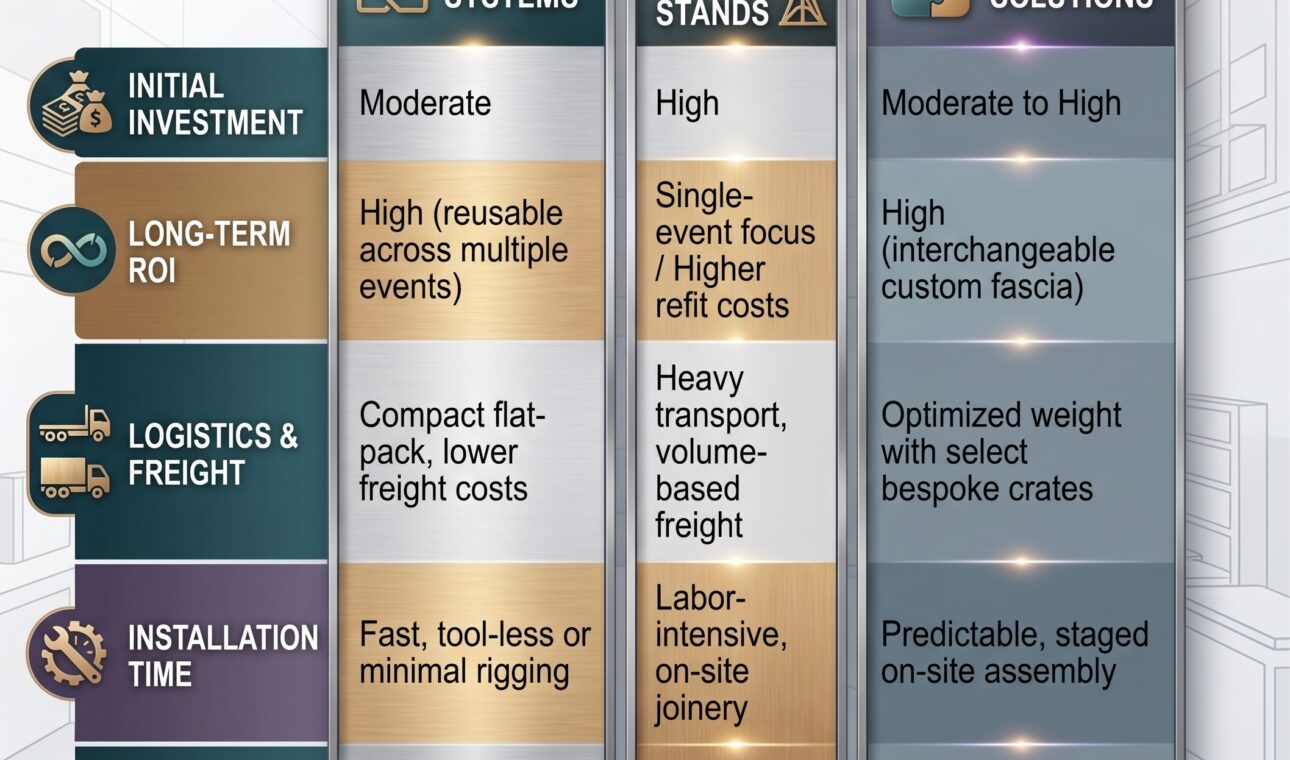
Modular exhibition stands utilize reconfigurable, lightweight structural systems, providing cost efficiency, reduced drayage, and rapid turnaround across multi-show schedules. Custom-built booths are fabricated from scratch with bespoke woodwork, unique architectural profiles, and dedicated materials to deliver maximum brand immersion for flagship trade events. A hybrid build combines standardized modular structural frames with custom-clad elements to achieve bespoke aesthetics at a predictable operational cost.
The Advantages of Modular Booth Systems
Modular display systems have moved far beyond generic pop-up banners.
Modern modular engineering uses precision aluminum framing, seamless silicone-edge graphics (SEG),
Integrated LED video walls, and standardized connection locks.
Footprint Adaptability:
A single modular inventory can configure into a $10\times10$ ft ($3\times3$ m) inline booth in Chicago, then expand into a $20\times20$ ft ($6\times6$ m) peninsula booth in Frankfurt by adding structural sections.
Lower Shipping and Drayage Fees:
Material weight directly impacts material handling fees (drayage) in US convention centers.
Lightweight modular components significantly lower these recurring line items.
Sustainability and Compliance:
Modular materials align directly with European trade show sustainability mandates (such as ISO 20121 standards), eliminating single-use drywall and timber waste.
When to Choose a Custom-Built Exhibition Stand
Custom builds remain the benchmark for category leaders seeking architectural impact and complex spatial configurations.
Complex Architectural Requirements:
Double-deck structures, cantilevered canopies, enclosed acoustic meeting rooms, and running water installations require custom engineering.
Distinct Materiality:
Custom builds allow for authentic brick, stone, curved woods, industrial steel, and high-end lacquer finishes that cannot be replicated with structural frames.
Flagship Brand Presence:
When exhibiting at your industry’s primary global summit (e.g., CES Las Vegas, Hannover Messe, or MWC Barcelona), custom builds deliver an unmistakable market-leader statement.
The Hybrid Approach: Combining Custom Aesthetics with Modular Economics
Global brands with active annual show schedules often adopt a hybrid framework.
By utilizing a modular core for walls, structural storage, and AV integration, paired with custom-fabricated reception counters, architectural arches, and 3D suspended signage, exhibitors capture the visual impact of custom design while maintaining modular efficiency.
Eventeam delivers hybrid and modular solutions tailored to your show calendar, engineering stands that scale smoothly between American convention centers and European exhibition halls.
Frequently Asked Questions
Can modular stands incorporate large AV screens and heavy displays?
Yes. Modern modular profiles are engineered with internal reinforcement to support large-format LED displays, touchscreen arrays, and integrated cable management systems safely.
How do booth regulations differ between the US and Europe?
European venues (such as Messe Frankfurt or Paris Expo) prioritize rigid fire-retardant certifications (B1/M1) and environmental disposal standards. US venues strictly enforce union labor jurisdictions, specific height restrictions based on booth types (inline vs. island), and localized electrical safety codes (UL/NFPA).