
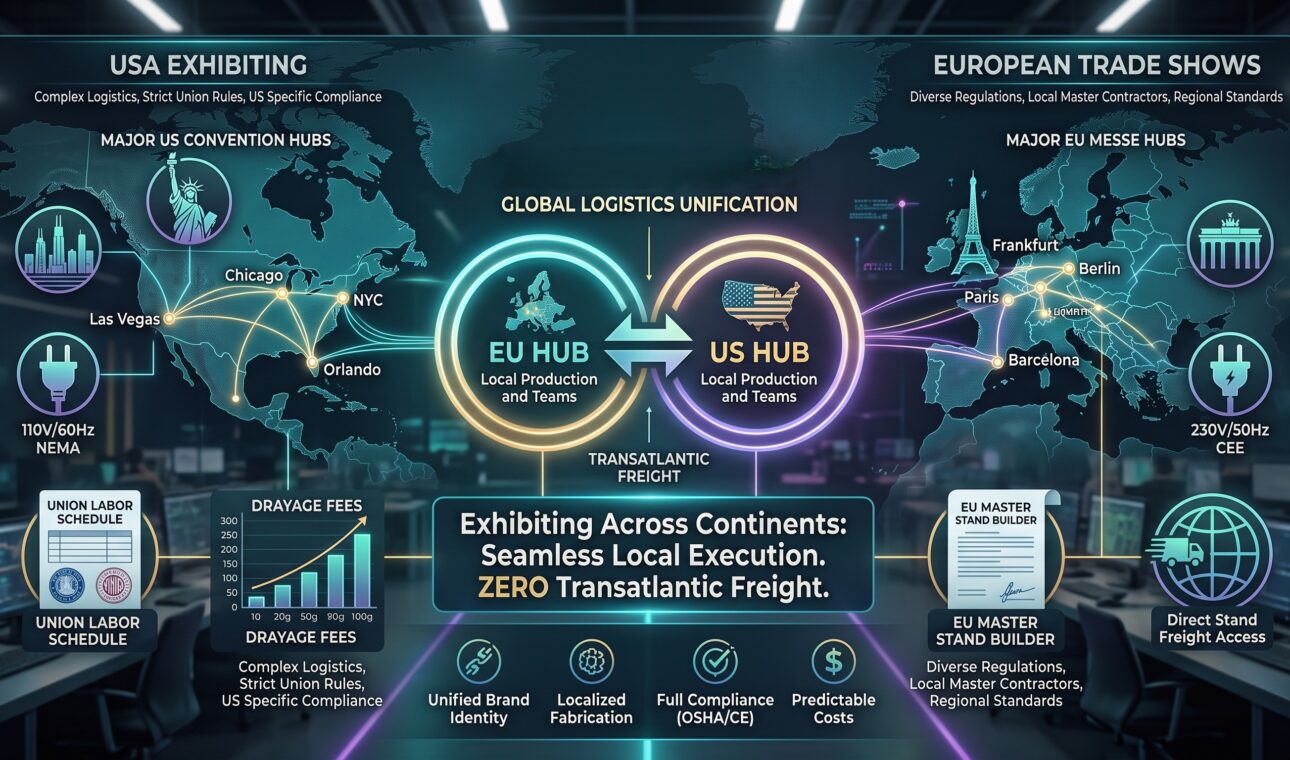
Managing trade show operations on multiple continents presents significant logistical, regulatory, and cultural challenges. A booth construction strategy that succeeds in Munich can encounter severe operational bottlenecks in Las Vegas if local convention rules, union regulations, and freight protocols are not accounted for in advance.
Executing successful international trade shows requires understanding the fundamental differences between North American and European exhibition landscapes, and establishing a localized production and project management footprint.
Key Logistical Differences: United States vs. Europe
Operating in these two markets requires distinct approaches to labor, material handling, and technical infrastructure.
- Labor Regulations and Union Jurisdictions
- In the United States: Major convention centers (e.g., Las Vegas Convention Center, McCormick Place in Chicago, Javits Center in NYC) operate under strict trade union jurisdictions. Specific tasks—such as electrical connections, hanging overhead trusses, laying carpet, and uncrating materials—are divided among designated labor unions. Work must be scheduled carefully to avoid costly overtime and double-time rates.
- In Europe: European venues generally permit accredited stand builders and contractors to handle full-scope construction from start to finish. Rigging and primary power drops are handled by venue-appointed contractors, while interior build-out remains under the direct control of your build partner.
- Freight, Material Handling, and Drayage
- The US Drayage Model: In the US, shipping your booth to the venue is only step one. Once it arrives at the dock, the general contractor charges “drayage” (material handling) based on weight to move crates from the loading dock to your booth space, store empty crates, and return them post-show. Heavy, unoptimized crates can incur unexpected drayage charges running into thousands of dollars.
- The European Direct-to-Stand Model: European logistics allow freight forwarders direct scheduled access to the exhibition hall floor during designated build windows, drastically lowering internal handling fees.
- Electrical and Technical Standards
- Voltage & Frequencies: The US operates on 110V/120V at 60Hz, while Europe utilizes 230V at 50Hz. All internal lighting, interactive touchscreens, and processing hardware must be dual-voltage compatible or powered via dedicated transformers.
- Fire & Safety Codes: Europe strictly mandates DIN 4102-1 B1 or EN 13501-1 fire retardancy certifications for all textiles, plastics, and wall panels. The US enforces NFPA 701 fire safety standards alongside OSHA safety compliances.
The Dual-Hub Advantage: Local Production in the US and Europe
Shipping completed exhibition stands across the Atlantic introduces high freight costs, customs clearance delays, carbon footprint penalties, and transit damage risks.
Working with a partner that operates dual manufacturing and storage hubs in both the US and Europe allows you to:
- Maintain Consistent Brand Identity: Run identical, unified design language on both continents managed by a single account team.
- Eliminate Transatlantic Freight: Produce and store components locally, paying domestic transit rates rather than international air or ocean freight fees.
- Ensure Full Regulatory Compliance: Leverage local project managers who understand the exact union rules in Orlando or the specific technical guidelines at Fira Barcelona.
Eventeam operates local production facilities in both Europe and the United States, providing end-to-end design, localized fabrication, and smooth on-site execution across all major global exhibition centers.